Open materials
TCP/IP: Concepts and IP Routing
An introductory course in two modules, first taught in 1999 and updated for this 2026 edition, in English and Brazilian Portuguese
A complete introductory training on how internetworks work and how IP finds its way across them: from bridges, routers and the routing algorithms, through the TCP/IP stack, addressing, ARP and a packet followed hop by hop, to RIP, EIGRP, OSPF, IS-IS and BGP-4, access lists, IPv6, multicast, MPLS and VRRP. Every one of the 178 slides carries speaker notes, so the course can be taught from the deck, or learned from it, without anyone else in the room.
Based on a course Rodolfo Nützmann first taught in March 1999, and rebuilt in 2026: 16:9 slides with the diagrams redrawn as native, editable shapes, the content updated to current practice (CIDR in place of address classes, EIGRP in place of IGRP, BGP-4, IPv6 as RFC 8200 defines it, PIM, VRRPv3), and the historical topics kept for their teaching value and marked LEGACY.
At a glance
- Level
- Introductory, from first principles to the routing protocols
- Format
- Slides (PDF) and editable deck with notes (PPTX)
- Slides
- 178 per edition, the same slides in both languages
- Speaker notes
- On all 178 slides, in both languages
- Languages
- English (US) and Portuguese (Brazil)
- Edition
- 2026
- First taught
- 1999
- Price
- Free, no sign-up
Who it is for
Learners. Read the PDF straight through, or open the PPTX in presenter view and read the notes as the commentary the instructor would give. The objectives at the start of each module and the summaries at the end tell you what you should be able to explain.
Instructors. The notes are written to be taught from: what to say on each slide, what to ask the class, where the common confusions are, and what changed since 1999. The deck is fully editable, the diagrams included, and the closing slides list the RFCs and sources by topic, so you can prepare yourself before you prepare a class.
A look inside
6 of the 178 slides, chosen for their diagrams. Each one opens at full size.
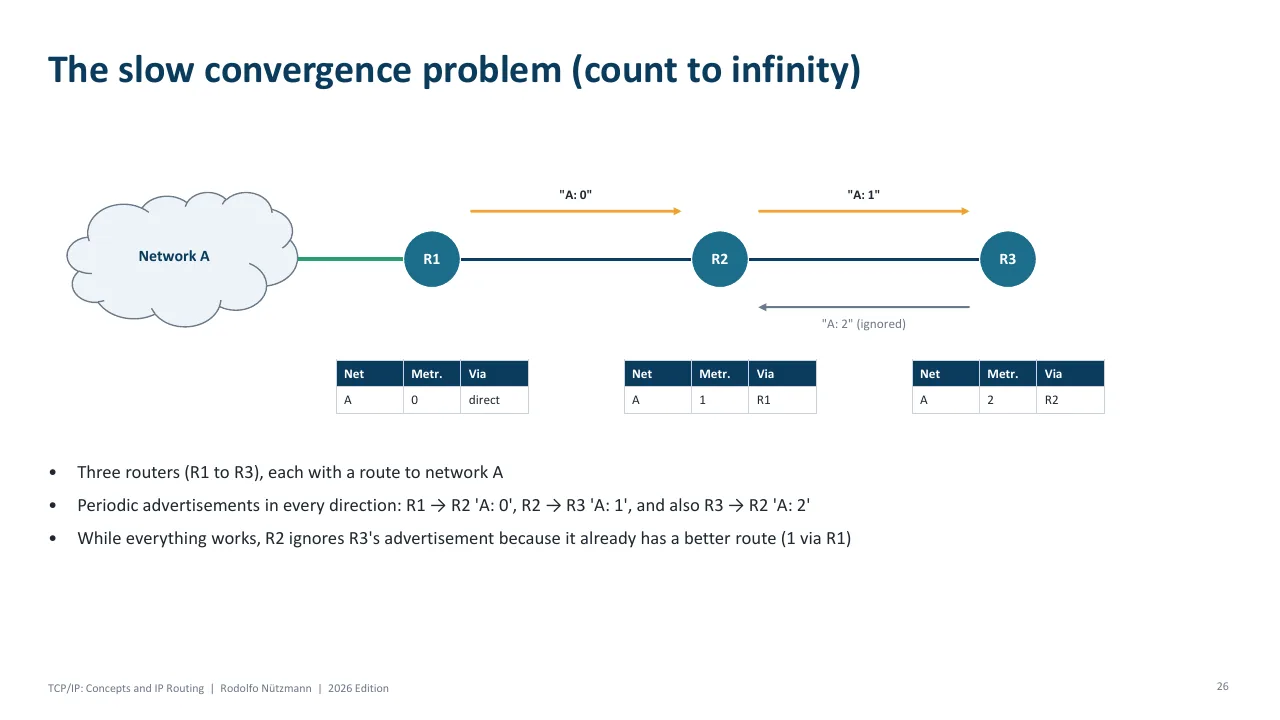
The slow convergence problem (count to infinity) 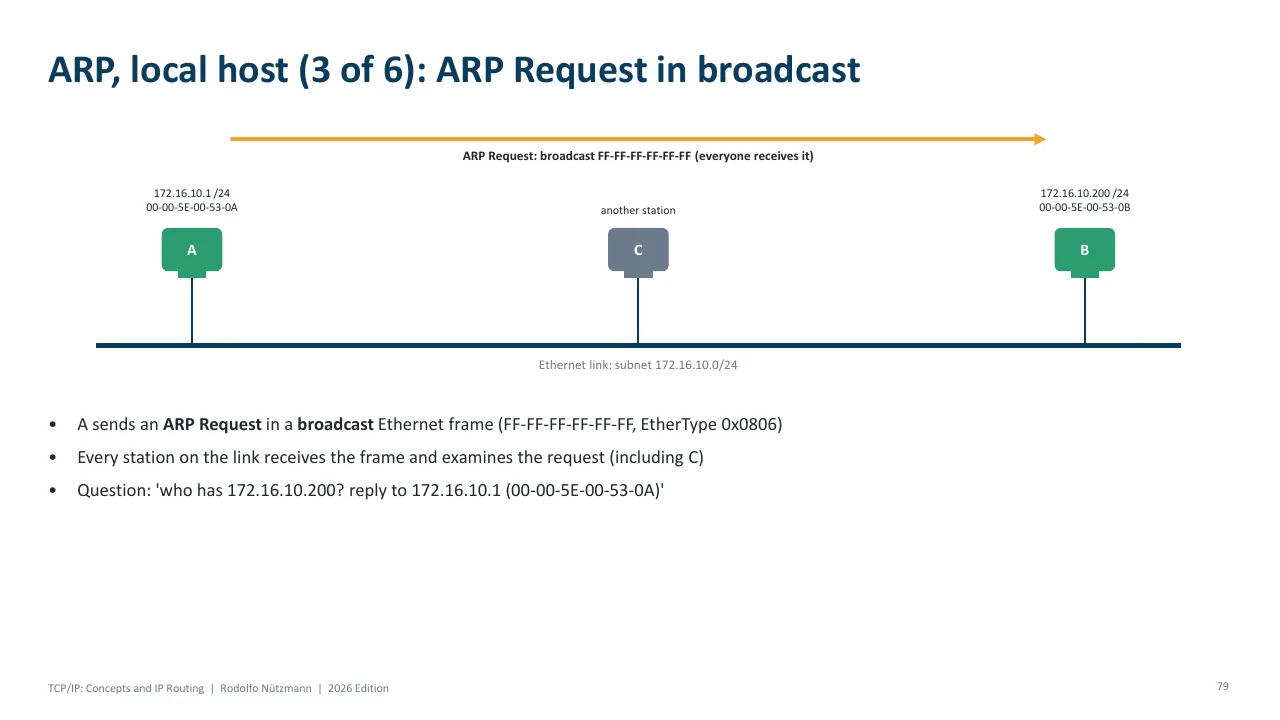
ARP, local host (3 of 6): ARP Request in broadcast 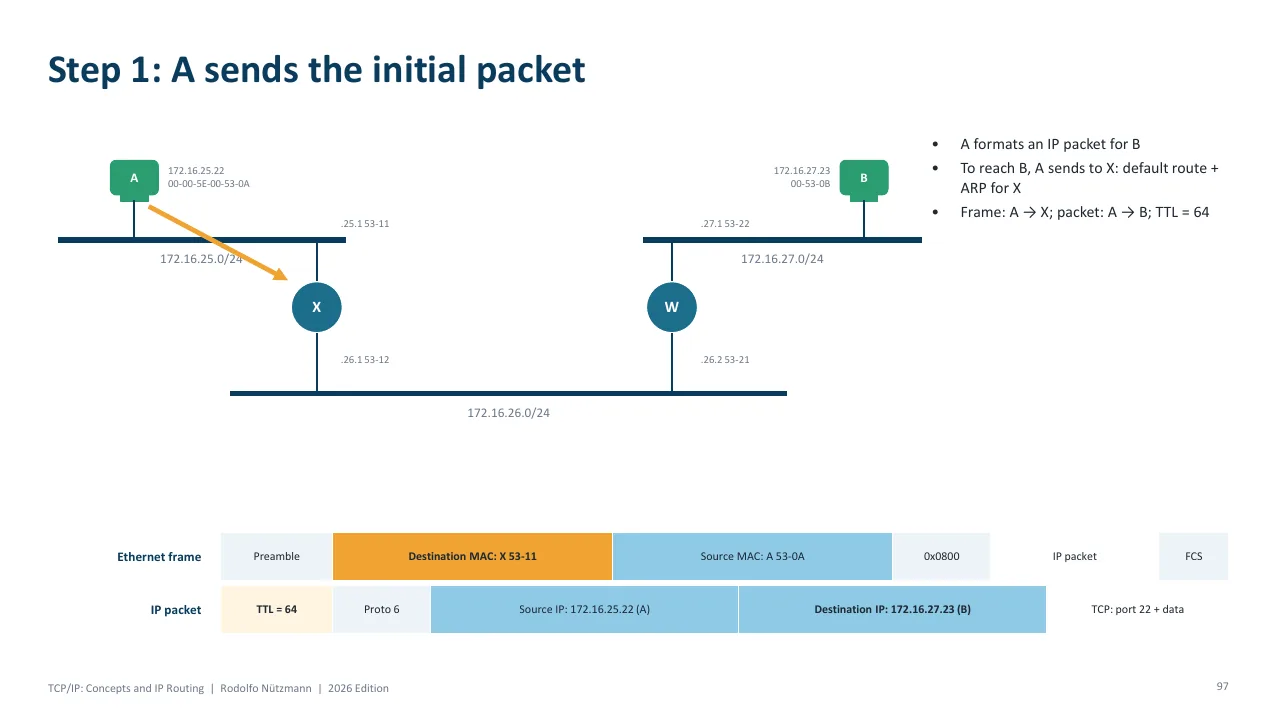
Step 1: A sends the initial packet 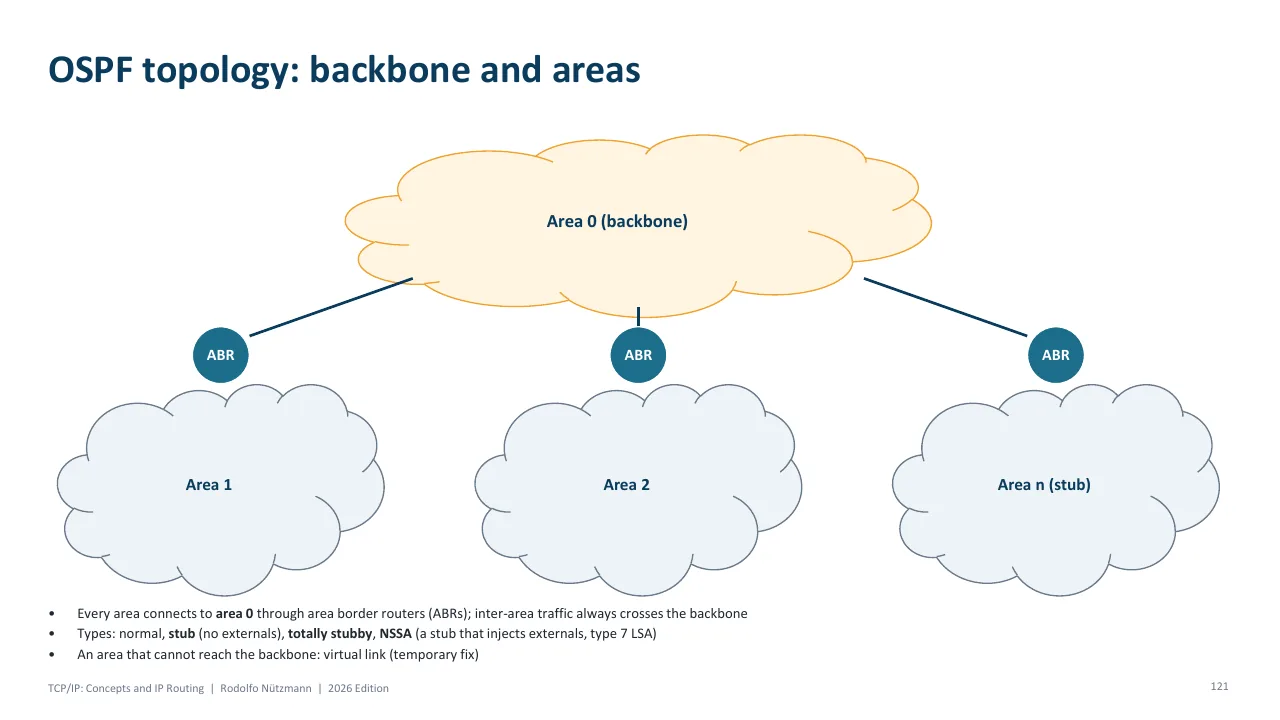
OSPF topology: backbone and areas 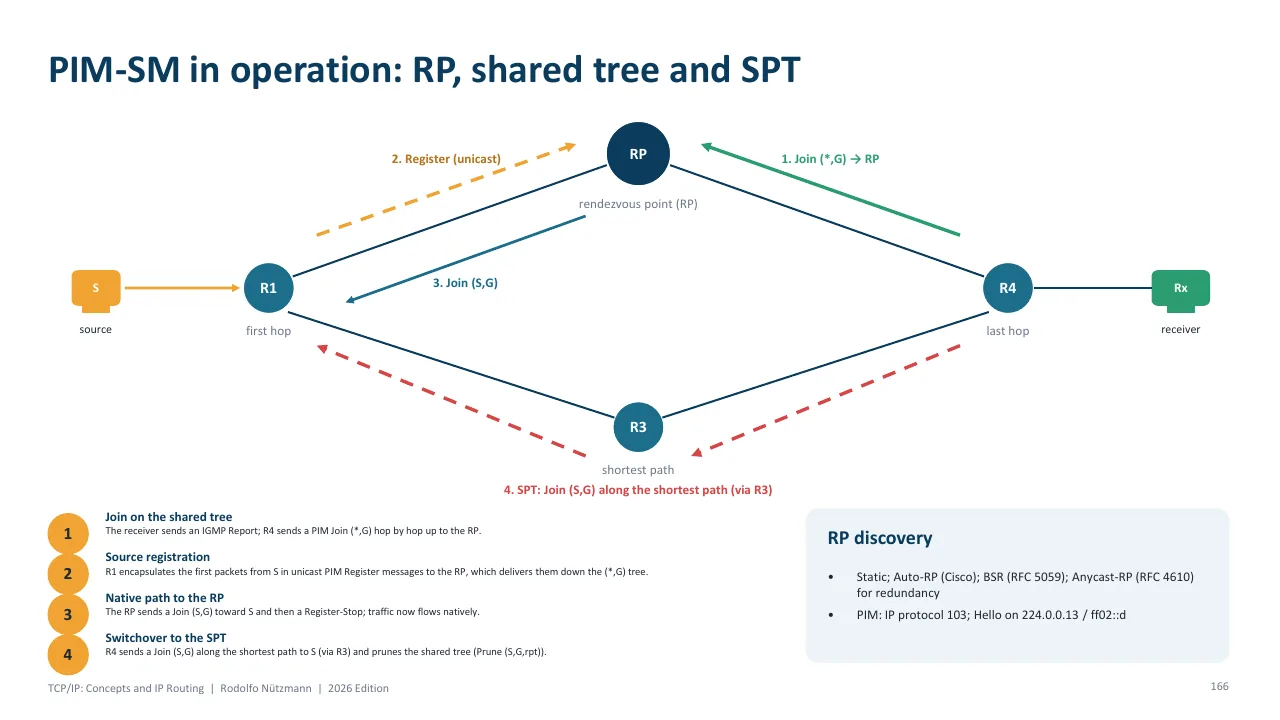
PIM-SM in operation: RP, shared tree and SPT 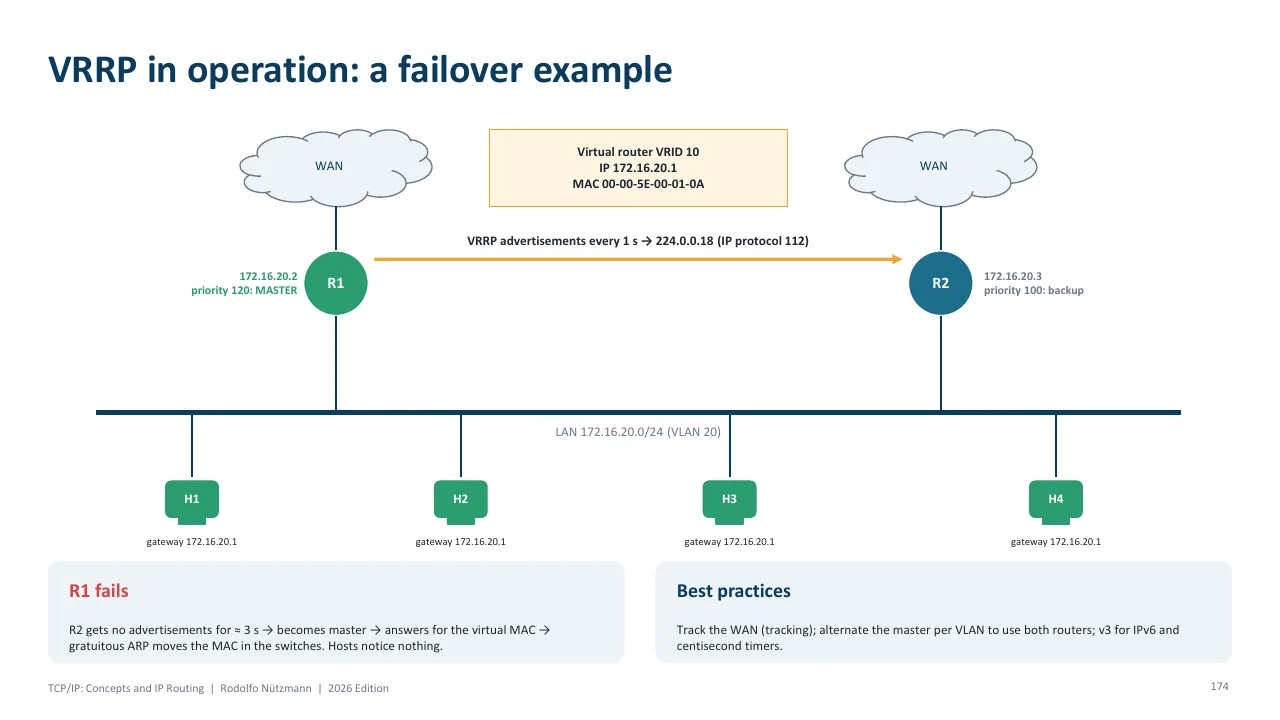
VRRP in operation: a failover example
Want this course taught live?
Rodolfo Nützmann teaches it as an instructor-led class for teams, on site or virtual, in English or Portuguese: a field veteran of three decades who teaches for a living, with real demonstrations and hands-on labs that take the subject past the slides.
Course outline
Slides 1 to 3 open the course (the title, the agenda and the 1999 to 2026 comparison below); slides 176 and 177 list the RFCs and sources by topic; slide 178 closes it.
Module 1
Part 1 · slides 4 to 41
General routing concepts
Present this part →- Heterogeneity and the components of an internetwork
- Interconnection devices and the OSI model
- Bridges and Layer 2 switches, the broadcast domain and Spanning Tree
- Routers: data flow, advantages and limitations
- Routable and nonroutable protocols
- Network-layer against data-link addressing, and encapsulation
- Static and dynamic routing
- Distance vector: metrics, count to infinity, split horizon, poison reverse, hold-down and triggered updates, with a worked example
- Link state: principles, advantages and the protocols in use
- Autonomous systems
Module 2
Part 2 · slides 42 to 66
TCP/IP
Present this part →- Origin and governance of TCP/IP
- The stack against the OSI model: application, transport and internet layers
- The IPv4 datagram in detail, protocol and port numbers, demultiplexing
- Decimal-to-binary conversion and the IPv4 address
- Classful addressing (legacy), CIDR and special-purpose addresses
- Subnets, the subnet mask and comparison under mask
- VLSM, with an addressing plan for a /24
Part 3 · slides 67 to 93
Internet Protocol behavior
Present this part →- Route determination: local or remote, with the AND
- Next-hop gateway lookup
- ARP (RFC 826) step by step, for a local and a remote host, with the request and reply packets
- Proxy ARP, with a worked example
- ARP in 2026: gratuitous ARP, the cache, security and IPv6
Part 4 · slides 94 to 104
IP in a routed internetwork: a complete example
Present this part →- The topology and the six-step data transfer, hop by hop
- Host names: from the hosts file to DNS
- Proxy ARP: vendor defaults
Part 5 · slides 105 to 134
IP routing protocols
Present this part →- RIP: origin, variants and the RIPv2 message
- Administrative distance
- From IGRP to EIGRP: the composite metric, DUAL and multipath
- Route redistribution and its risks
- OSPF: areas, router types, network types, Hello, adjacencies, DR and BDR, LSAs and the LSDB, inter-area and external routes
- OSPFv3 and IS-IS
- Interior against exterior protocols, EGP, and BGP-4 attributes and best-path selection
Part 6 · slides 135 to 140
Controlling IP access
Present this part →- ACLs in the router's processing flow
- Standard ACL examples: permit the internal network, deny a host, deny a subnet
- ACLs in 2026: extended, named, IPv6 and stateful firewalls
Part 7 · slides 141 to 145
Additional IP routing topics
Present this part →- IP broadcast handling and the DHCP problem
- DHCP relay and directed broadcast
- Secondary addresses
- Unnumbered interfaces
Part 8 · slides 146 to 157
IPv6: from 'IPng' to the dominant protocol
Present this part →- From 'IPng' (1995) to RFC 8200 (2017)
- The differences from IPv4, the header and the extension headers
- Addressing: 128 bits, three types, no broadcast; types and scopes
- Neighbor Discovery and SLAAC
- Routing, flows and traffic class, security
- IPv4 and IPv6 transition and coexistence
Part 9 · slides 158 to 167
IP multicast
Present this part →- Multicast addresses and their mapping to MAC addresses
- IGMP and MLD
- Dense against sparse mode and the RPF check
- Multicast routing protocols, and PIM-SM: the RP, the shared tree and the SPT
- RSVP, and what is left of it
Part 10 · slides 168 to 175
MPLS and VRRP
Present this part →- Label switching and its terminology
- FIB, LIB and LFIB, with an example
- MPLS applications in 2026
- VRRP: default gateway redundancy, with a failover example
- The Module 2 summary
Learning objectives
Module 1
- Internetworking vocabulary. Recognize the basic internetworking terms and concepts: LAN and WAN links, interconnection devices, broadcast and collision domains.
- Bridges and switches versus routers. Compare the operation of bridges/Layer 2 switches and routers, and understand Layer 2 and Layer 3 switching.
- Routable protocols. Describe the properties of a routable protocol and put nonroutable protocols in historical context.
- Distance vector. Explain the principle of operation, the inherent instability (slow convergence) and the techniques that correct it.
- Link state. Explain SPF (Dijkstra) algorithms, their advantages over distance vector and the protocols that implement them.
- Autonomous systems. Define autonomous system and distinguish interior from exterior routing protocols.
Module 2
- Characteristics of TCP/IP. Protocol stack, IPv4 datagram, protocol and port numbers, addressing, subnetting and VLSM, host-to-host communication, ARP and Proxy ARP.
- The IP routing process. Describe in detail, step by step, what happens to a packet between the source station and the destination station in a routed internetwork.
- RIP and EIGRP. Recall the fundamentals of RIP (v1, v2, RIPng) and of EIGRP (composite metric, DUAL, multipath) and the role of administrative distance.
- Redistribution and OSPF. Discuss route redistribution between routing processes and recall the principles of OSPF (areas, router types, Hello, DR, LSAs).
- BGP-4. Distinguish interior from exterior protocols and describe the fundamentals of BGP-4 (path vector, eBGP/iBGP, attributes).
- Access control. Recall how access control lists (ACLs) on routers filter IP traffic, and how they evolved into stateful firewalls.
- Operational topics. Broadcast handling (DHCP relay), secondary addresses, unnumbered interfaces, static and default routes.
- IPv6 and complementary technologies. Understand IPv6 (header, addressing, ND/SLAAC, routing, transition), IP multicast (IGMP/MLD, PIM), RSVP, MPLS and VRRP.
From 1999 to 2026
| Topic | In 1999 | In 2026 |
|---|---|---|
| LAN links | Ethernet 10/100, Token Ring, FDDI | Ethernet 1G to 400G, Wi-Fi 6/7; Token Ring and FDDI extinct |
| Network protocols | TCP/IP, IPX, AppleTalk, DECnet, SNA | IP only (IPv4 and IPv6); the rest is legacy |
| IPv4 addressing | Classes A/B/C, contiguous subnets | CIDR/VLSM (RFC 4632); IPv4 exhaustion (IANA 2011, LACNIC 2020); NAT and CGNAT |
| IPv6 | "IPng" in draft (RFC 1883) | RFC 8200 (2017); > 50% of Google access (Mar 2026); Brazil ≈ 59% (APNIC, Oct 2026) |
| IGP | RIP, IGRP, OSPF | OSPFv2/v3, IS-IS, EIGRP (RFC 7868); RIP only in small networks |
| EGP | EGP on the way out, BGP-4 arriving | BGP-4 (RFC 4271) universal; 32-bit ASNs (RFC 6793) |
| Multicast | DVMRP, MOSPF, MBone | PIM-SM/SSM (RFC 7761, RFC 4607), IGMPv3/MLDv2 |
| Gateway redundancy | VRRP just published (RFC 2338) | VRRPv3 (RFC 5798) for IPv4 and IPv6; HSRP |
| Layer 2 interconnection | Bridges, STP 802.1D | Multilayer switches, RSTP/MSTP, 802.1Q VLANs, EVPN |
The comparison is slide 3 of the course itself, with the figures its notes say were verified in October 2026.
Downloads
| File | Size | SHA-256 | Download |
|---|---|---|---|
| English (US) · PDFReader's edition: the slides, for reading and printing | 1,3 MB | 1200491e565cc2d00b99465b01d925c9b4a67d02563eb54a8d77d13ec5ab2355 | DownloadRead online |
| English (US) · PowerPoint (PPTX)Instructor's edition: the editable deck with the speaker notes | 0,8 MB | ef51eb558de1d2e088005685d8d1d209ea08f9bba9b2ab59c8981a00957fbf95 | Download |
| Portuguese (Brazil) · PDFReader's edition: the slides, for reading and printing | 1,8 MB | 7a7cc379826e60fb864026bc948cbc632c7b764d5f87b36a95cec339ef0beb9a | DownloadRead online |
| Portuguese (Brazil) · PowerPoint (PPTX)Instructor's edition: the editable deck with the speaker notes | 0,8 MB | 43ea465cb39750947836b69a9620349605666667da82b24f9f92b360a217d72e | Download |
Licence
Offered under CC0 1.0 Universal. You can copy, modify, translate, distribute and teach with this course, commercially or not, without asking permission.
Credit to Rodolfo Nützmann is appreciated, never required. As the CC0 deed asks, do not imply endorsement by the author when you use the material.
Learn more on this site
Articles that teach the same ground in more depth, from the Learn library.