The article this one argues with
There is a piece in the catalogue called the founders who kept founding. It reads the networking industry as an entrepreneurial population rather than a sequence of firms: the same people recur, and the companies are what they happened to be doing at the time. Ungermann left Intel for Zilog and Zilog for Ungermann-Bass; Metcalfe left the lab where was invented to found 3Com. It is a true and useful way to see the field.
It also names its own blind spot, and I want to write from inside that blind spot. The article puts it plainly: a history told through its recurring founders becomes a history where only the recurring founders are visible, and the engineers who stayed, who made one company work and never founded anything, do not appear, though much of what got built was built by them.
I am one of the people who stayed. My whole career runs through one company and its wreckage, and I watched the switch's history happen from a seat the founder story does not have.
1996: the wiring closet of the early 1990s, a few years late
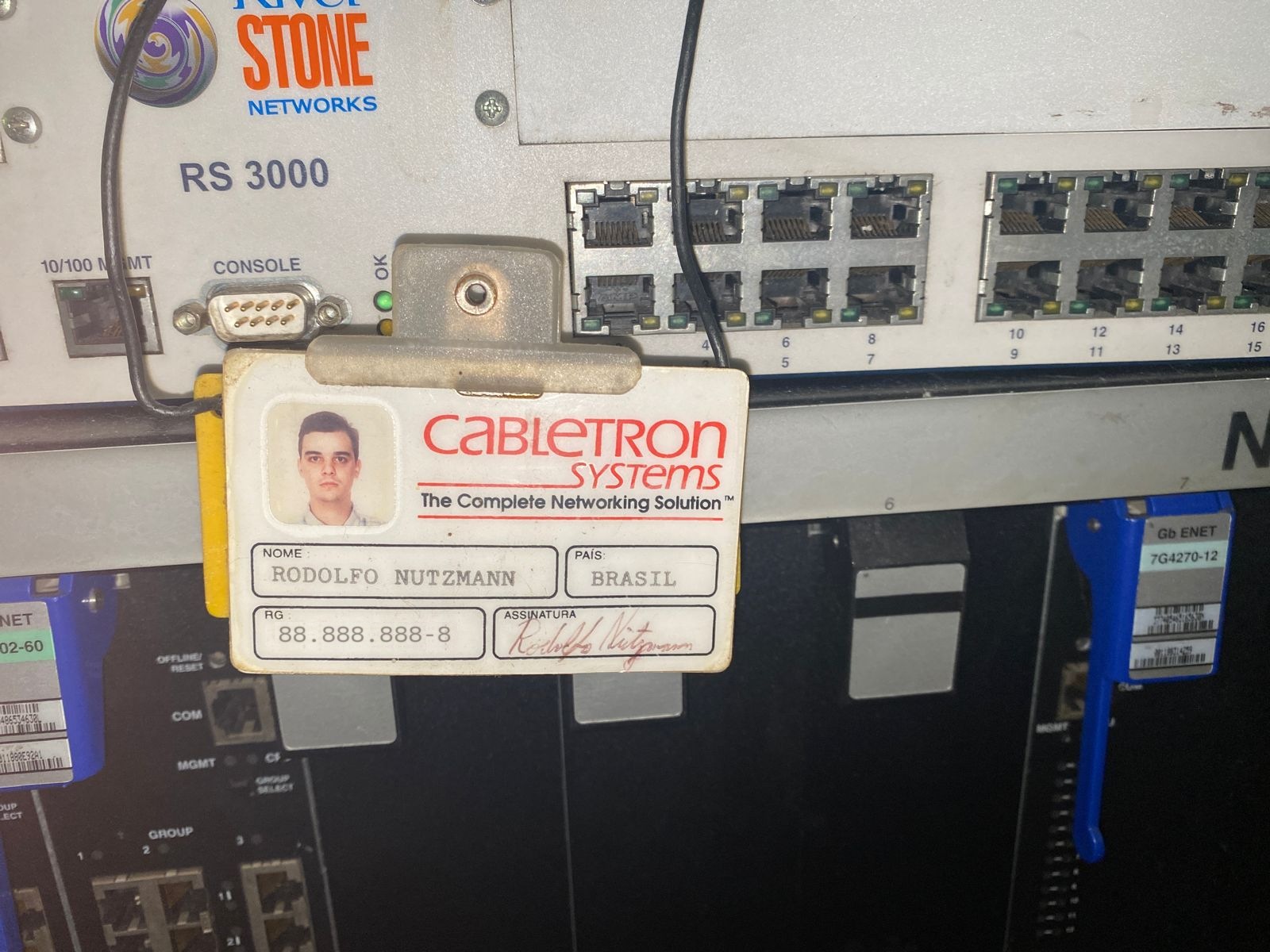
I started at Cabletron Systems in 1996. If you did not live through it, the name means nothing now; at the time it was one of the industry's big four, alongside Cisco, Bay, and 3Com, and it had passed a billion dollars in revenue that year. It had been started in 1983 by a cable salesman and a materials specialist cutting Ethernet cable in a garage because no supplier would sell it in small lots, and it moved to New Hampshire in 1985 for the taxes and for the engineers that Route 128's dying minicomputer companies were shedding. Its founder ran sales meetings in combat fatigues. None of that was visible from São Paulo. What was visible was the equipment.
And the equipment was the switch's whole history, arriving in a I was responsible for. The MMAC modular hubs, the high-density 10BASE-T modules, the element manager on top: this was the transition the lineage article describes in the abstract, from shared-media hubs where every port heard every frame to switched ports where they did not, and I was installing it, breaking it, and fixing it in production. The lineage article can tell you that the field moved from bridging to switching to silicon-per-port. I can tell you what it smelled like to relocate a redundant managed network for a bank over a weekend and have it up on Monday.
That is the first thing the seat gives you that the founder story cannot: the technology in these histories is not a diagram. It is a thing that was heavy, ran hot, and belonged to someone whose business stopped if you got it wrong.
2000: the company becomes four companies
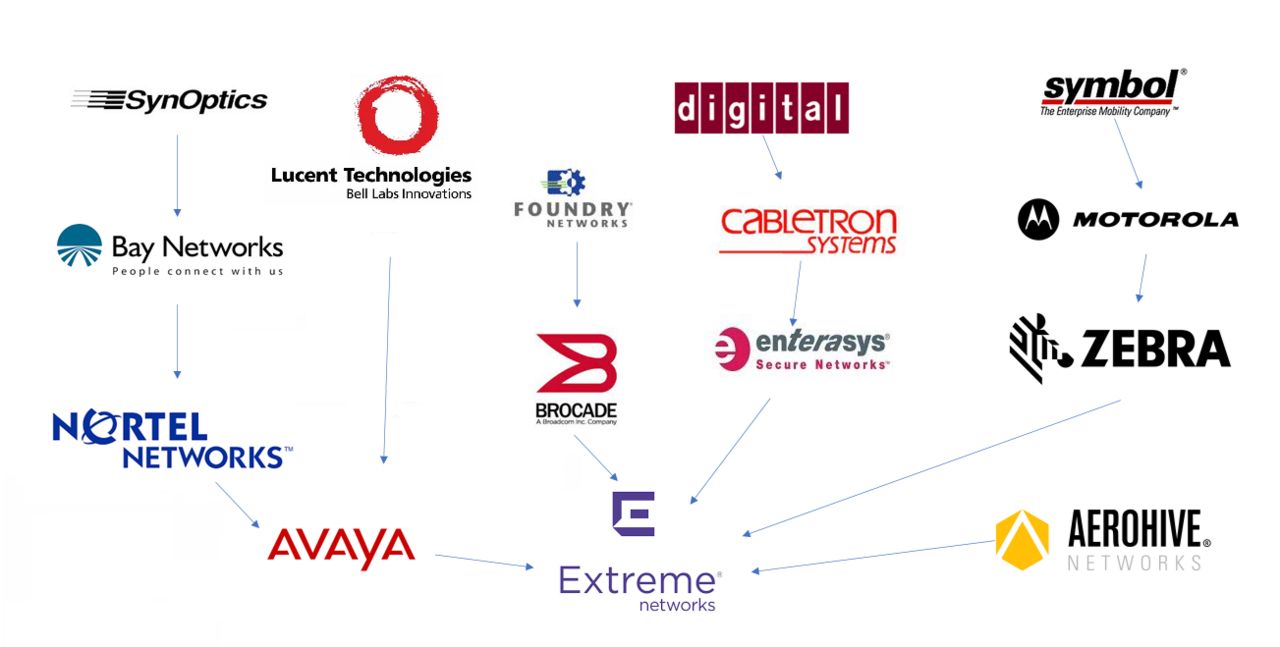
In February 2000 Cabletron did something I have never seen another company do so completely. It split into four. Not a spin-off, not a divestiture, but a clean break into four independent companies, with the parent left as a holding shell and the factories already sold. Riverstone Networks took the service-provider business and the wire-speed routing line to Santa Clara. Enterasys took the enterprise and stayed in Rochester. Aprisma took the management software. A fourth took professional services.
Here is where the founders article and my career diverge in an instructive way. For the founders, the split was a liquidity event and a starting gun: capital and reputation released into the next thing. Several of the people whose names are on that split went on to found or run other companies; that is the pattern the article is about, and it is real.
For me, the split was not an opportunity to recombine. It was the ground moving. I went to Riverstone (to Santa Clara, first on an L-1 intracompany transfer and then on an H-1B visa) and did third-level escalation on the metropolitan-area equipment: recreating customer faults in the lab, regression testing, building the knowledge base. Same lineage, new company, new country. Then in 2005 I was back on the enterprise side at Enterasys, which was the other half of the same original company, working on the same class of switches and routers I had started on, plus the network access control that the NAC lineage calls the idea that was right too early. One firm had become two, and I worked for both of its halves, doing continuous work across a discontinuity that, on an org chart, looks like two unrelated employers.
That is the second thing the seat gives you: an acquisition or a split is one event from the outside and a completely different event depending on which side of it you are standing on. The founders article says an acquisition is usually the beginning of somebody's second company. From where I sat, it was the beginning of my needing to learn the same technology's new name.
The house style nobody chose
The founders article has a line I have felt from the inside more than any other: rival products from firms founded by the same cohort often share assumptions that look, decades later, like a house style nobody chose, because people carry their priors from company to company.
I carried mine. When I moved from Cabletron to Riverstone to Enterasys, I did not arrive neutral. Five years of watching one company's approach to network management, one company's idea of what a managed switch owed its operator, one company's instinct about redundancy: those came with me, and they shaped how I read the next company's product even when the next company was, technically, a different company. And because Riverstone and Enterasys were both made of Cabletron, the priors fit. The house style was not chosen. It was inherited, in the literal sense: the same engineering DNA, split across two buildings, expressed twice.
You can only see that if you were the . From the outside, Riverstone and Enterasys were competitors in adjacent markets. From my seat they were siblings who had learned to argue in the same language because they were raised in the same house.
Where it went, and the part that is uncomfortable
The lineage article ends by noting two things: that the switch's market today is Cisco, Arista, Juniper, HPE through Aruba, Extreme, Huawei, and the white-box vendors, and that the most interesting development is the unbundling of the switch from its operating system for the first time since the field began. Enterasys is on that list only as ancestry: Extreme Networks acquired it, and the line I started on in 1996 now ships, when it ships at all, inside a company I would later be an authorized instructor for. Riverstone was bought and effectively dissolved. Aprisma was absorbed. The four-way split ended as most of the pieces do: inside other companies' logos.
The uncomfortable part, and the reason I keep the obsolescence article close, is that almost none of what I spent that decade mastering is directly useful now as technology. The specific management platform, the specific module densities, the specific certifications (Cabletron Systems Engineer, Enterasys Systems Engineer, Enterasys Certified Internetworking Engineer) are archaeology. If the value of those years were the products, the years would be worthless.
But the value was never the products. It was the shape, which is exactly what the industry-from-inside articles are about: how a product travels from the people who build it to the people who run it, what breaks when a company reorganises, how engineering priors propagate, what an acquisition actually does to the people inside it. That does not go obsolete, because the next wave has the same shape. When virtualisation split into a dozen companies, when software-defined networking did, when cloud security did, the population recombined and the survivors got absorbed, exactly as they did in Rochester in 2000.
What the stayer knows
The founders article is right that the movers generate the events and the stayers do not, which is why the history gets written about the movers. But there is a knowledge that only the stayer has, and it is worth naming because the industry systematically undervalues it.
The mover knows how to start the next company. The stayer knows what it is like to be inside the thing when it changes owners: to keep a bank's network running while the company that made the equipment is being cut into four, to learn that the product you support has a new logo and a new roadmap and the same silicon, to carry a decade of hard-won instinct across a discontinuity that looks, from outside, like you simply changed jobs. Both kinds of knowledge are real. Only one of them tends to get written down.
I am writing this one down because I have spent thirty years being the person the founder story leaves out, and because the seat turns out to have the better view of the one thing the founder story keeps getting slightly wrong: the companies are not the history. The people are, and most of the people stayed.